Case study
A lawyer inherited an 8-year file with 2,500+ pages. By the same day, they were ready to respond.
This is what happens when legal teams stop spending days reconstructing context before they can act. A lawyer inherited a multi-year matter with no clear picture of its current state. Within hours, they had a grounded understanding of the file and moved into same-day action.
File history
8 years
Documents and emails
120+
Record size
2,500+ pages
Working understanding
≈2 hours
The bottleneck
The judgment was there. The story was scattered.
The first move
“Where is this file at right now?”
In the traditional workflow, answering that means identifying the latest correspondence, understanding how it fits into the prior history, and verifying that understanding against the record.
Legalfy Cloud surfaced the current procedural posture and most recent developments in minutes.
Each point stayed tied to the underlying record so the lawyer could verify before relying on it.
Instead of losing the morning to orientation alone, the lawyer moved directly into targeted review and next-step thinking.
What changed
Instead of reading 2,500+ pages front to back, the lawyer navigated the file through focused questions.
Step 1
They started with a simple question: where is this file at right now?
Step 2
Legalfy Cloud surfaced a clear current picture tied to supporting records the lawyer could immediately check.
Step 3
From there, the lawyer moved through targeted follow-up questions instead of trying to absorb 2,500+ pages in order.
The result
The lawyer went from inherited-file chaos to same-day action.
Within hours, the lawyer had a working understanding of the file: posture, issues, history, and current state surfaced from the record.
By the same day, they drafted a response letter with the supporting records close at hand.
What normally burns days of catch-up was compressed into a single working session without guessing or cutting corners.
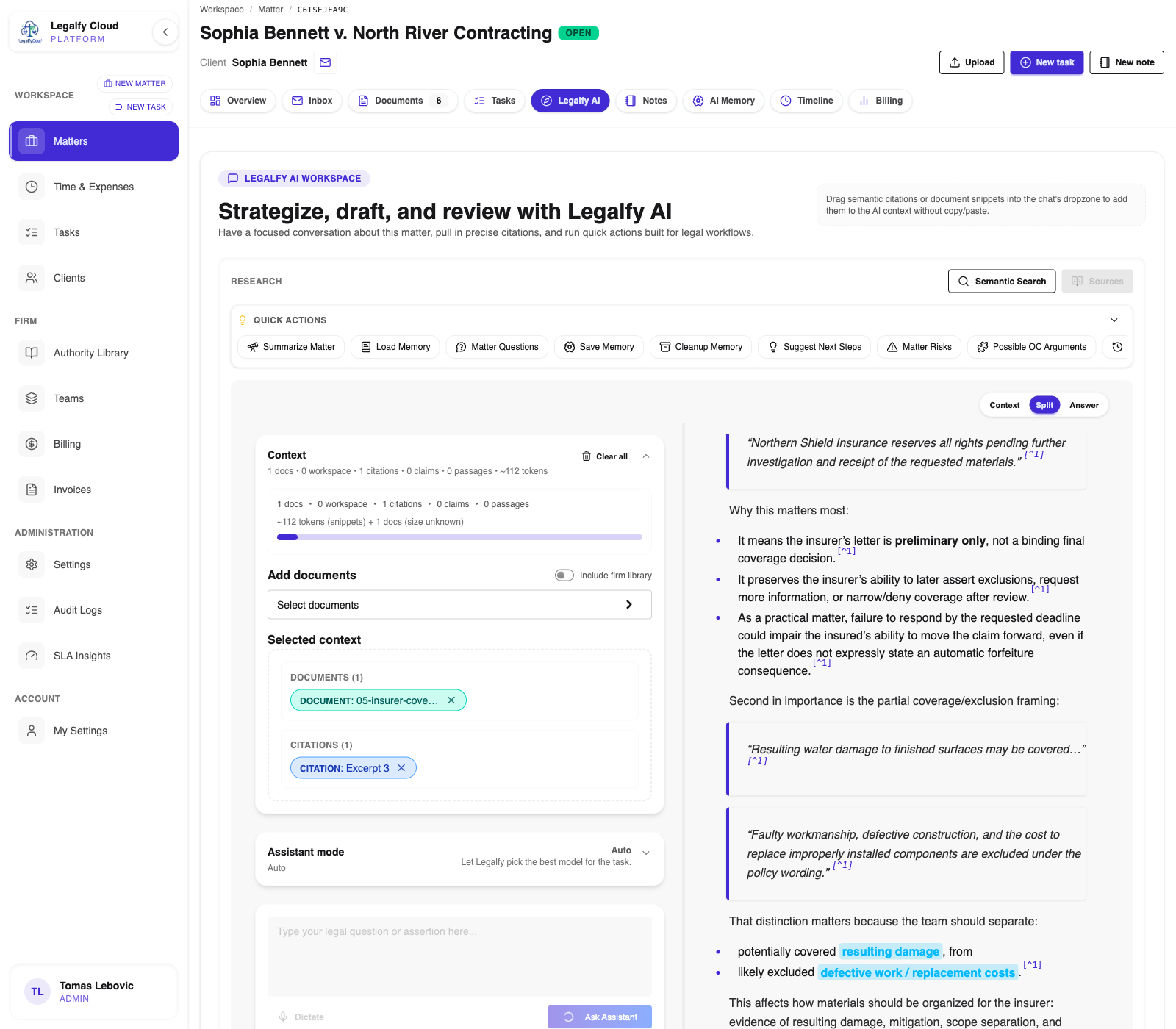
Proof Snapshot
The Lawyer Could Follow the Answer Back to the Record
The value was not a faster answer alone. The lawyer could review the supporting material, refine the question, and move into a response with the file still visible.
This case study reports one anonymized workflow. Matter details are intentionally omitted.
Outcome
A file that would often consume days of catch-up was understood in hours and acted on the same day.
Why this matters to firms
Give experienced people more time for the work only they can do.
Less time lost to orientation overhead before a lawyer can become useful on a complex file.
Faster handoffs when a matter changes counsel, escalates, or lands with someone new.
More of the day goes to strategy, response, and client-facing action instead of reconstructing the past.